Decoloniality Without Colonization:

How Iranian Education Was Rewritten by Invisible Empires
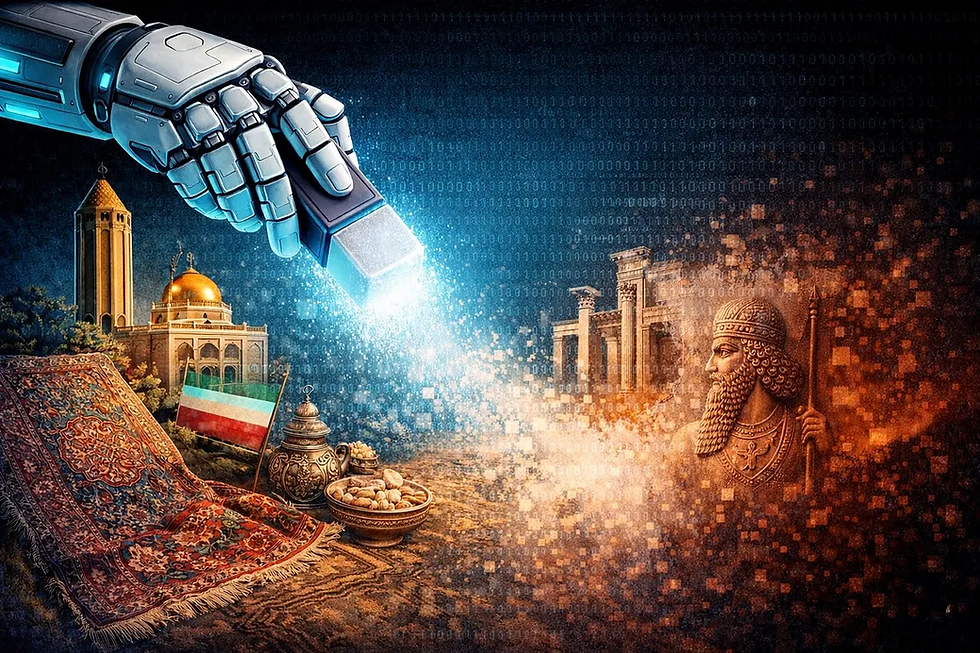
Coloniality works by deciding what counts as real knowledge. In many countries, including Iran, Western scientific rationality was positioned as the only legitimate way to understand the world. Persian intellectual traditions, ecological medicine, metaphysics, and poetic or spiritual approaches to learning were pushed aside. They were treated as cultural artifacts rather than serious knowledge systems. This pattern was repeated across the globe. Western knowledge became the default standard, while other traditions were reframed as outdated or unscientific.
Yet Persian knowledge systems were not peripheral or ornamental. They were fully developed ways of knowing, each with its own methods, logics, and standards of truth.
Persian metaphysical traditions understood knowledge as illumination. Insight was not something extracted from the world but something revealed through inner clarity, ethical refinement, and disciplined perception. Truth emerged gradually, as the mind and character became capable of recognizing it.
Persian ecological medicine approached the body as an interconnected system shaped by temperament, environment, and balance. Knowledge came from long-term observation of patterns across generations. It was empirical, but relational rather than reductionist. Instead of isolating variables, it studied how elements interacted within a living whole.
Persian poetic and literary traditions treated language as a tool for accessing forms of understanding that cannot be reached through direct explanation. Poetry was a method of inquiry. Metaphor, rhythm, and imagery were used to reveal truths that emerge through resonance, intuition, and emotional intelligence.
Persian spiritual and philosophical schools emphasized learning as a transformation of the self. Knowledge required cultivating humility, patience, and ethical character. A person did not master a subject; they became attuned to it. Learning was inseparable from becoming.
Across these traditions, learning was understood as relational, embodied, ethical, contemplative, experiential, and non-linear. Knowledge unfolded through connection, practice, and inner transformation. It was not measured by speed, output, or behavioural compliance, but by depth, clarity, and the refinement of judgment.
These were not primitive versions of Western science. They were different epistemic architectures built on different assumptions about what the world is and how humans come to know it. Coloniality dismissed them not because they lacked rigor, but because they did not conform to Western definitions of rigor. And today, AI extends this hierarchy by embedding Western assumptions into the very systems that structure learning.
References
Knox, J., Williamson, B., and Bayne, S. (2020). Machine behaviourism, future visions of learnification and datafication across humans and digital technologies. Learning, Media and Technology, 45(1), 31–45.
Zembylas, M. (2023). A decolonial approach to AI in higher education teaching and learning, strategies for undoing the ethics of digital neocolonialism. Learning, Media and Technology, 48(1), 25–37.


Comments