Recasting a Revolution

What Iran Protests 2026 Reveal About Media Power Today

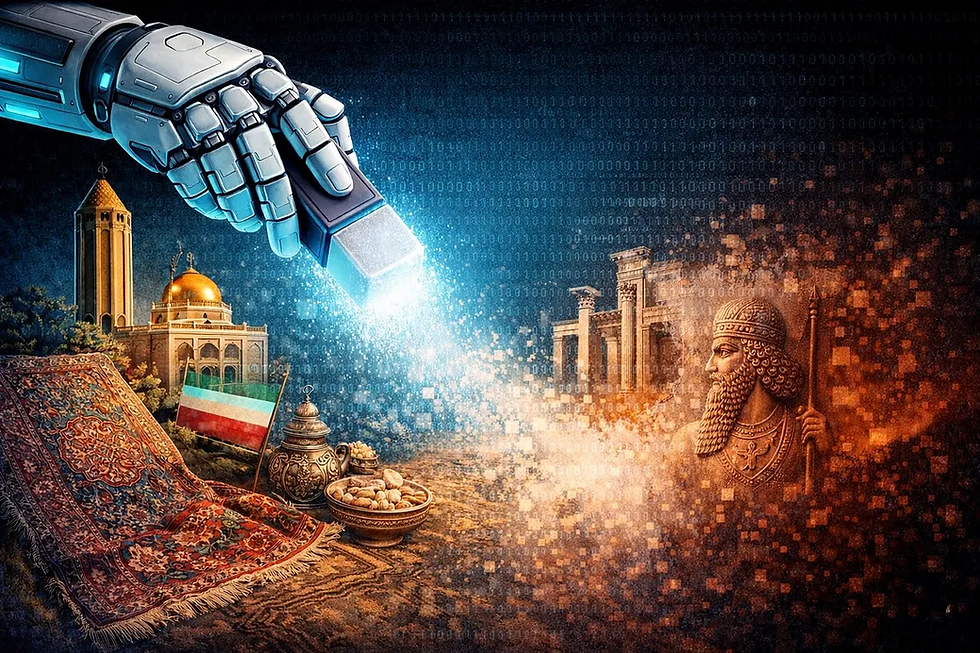
The recent unrest in Iran in December 2025 was not only a confrontation in the streets, but a contest over its meaning. Long before the first videos from inside the country could surface, parts of the Persian‑language media ecosystem had already imposed a ready‑made storyline onto the unfolding events, a narrative shaped from afar and projected onto a movement whose own voice had yet to be heard. The uprising itself began on December 27, 2025, emerging from a landscape strained by hazardous winter pollution, a currency collapse that erased purchasing power overnight, and the lingering effects of months‑long water shortages earlier in the summer. Even as the government briefly relaxed its enforcement of mandatory hijab laws in an attempt to defuse public anger, the underlying pressures continued to mount. This context set the stage, but it was not the force that shaped the story that followed.
The immediate spark came from Tehran’s commercial heart. As the rial plunged to record lows, traders in the Jomhouri and Saadi districts shuttered their shops, and demonstrations quickly formed around the Grand Bazaar. Reporting from Firstpost indicates that shopkeepers closed their businesses on December 30, 2025, at 6:00 p.m. IST because the currency collapse made pricing goods impossible and daily transactions unsustainable (Firstpost, 2025). What began as an economic stoppage among merchants soon spilled into the surrounding streets, where demonstrators chanted against inflation, corruption, and the government’s mismanagement of the economy.
Within a day, the unrest had spread far beyond Tehran’s commercial centers. According to ABC News, shop owners in cities such as Hamedan and Qeshm also closed their stores and joined the demonstrations, while protesters in Zanjan and other regions chanted slogans directly targeting the country’s leadership (Malekian, 2025). The collapse of the rial, fluctuating between 1.38 and 1.45 million per U.S. dollar, intensified public anger and contributed to the resignation of the head of Iran’s Central Bank, a development confirmed by state media and international reporting (Malekian, 2025). By December 30, university students had entered the streets in force. Students at Khajeh Nasir University in Tehran chanted slogans linking economic hardship to political repression, including demands for freedom and equality. As ABC News reports, these demonstrations marked a shift from narrowly economic grievances to broader political demands, echoing the language of earlier nationwide movements (Malekian, 2025). The protests quickly became the largest Iran had seen since the 2021–2022 uprising following the death of Mahsa Amini.
The regime’s response, while stopping short of a nationwide internet shutdown, followed a familiar choreography: targeted crowd‑control tools, tear gas in public squares, water cannons in busy corridors, irritant sprays at close range, and selective physical confrontations. Shopkeepers in some districts reported forced closures; students faced detentions and restricted movement on campuses; and a heavy security presence in bazaars and commercial centers created an atmosphere of intimidation. Official closures, attributed to “cold weather and energy saving”, emptied public spaces, while online disruptions slowed uploads enough to delay real‑time documentation. In parallel, state‑aligned media framed the protests as “externally guided,” attempting to delegitimize the movement and fracture public sympathy.
From the very first hours, however, foreign‑based Persian‑language media outlets, including Iran International, Manoto, Independent Farsi, and BBC Persian, cast the unrest through a pre‑existing political lens. Their coverage did not merely report events; it actively shaped the interpretive frame through which the uprising was understood abroad. Their rapid portrayal of the earliest chants as expressions of support for Reza Pahlavi raises questions about the priorities guiding their editorial choices. Pahlavi, the exiled son of Iran’s last monarch, remains a symbolic figure for segments of the diaspora, yet he lacks an organized political presence inside the country. The narrative built around him, however, was ready long before the protests began, and it was quickly applied to a movement that had not yet spoken for itself.
Unlike previous waves of unrest, authorities did not impose a nationwide internet shutdown during the first days of the protest. Yet the absence of a full shutdown did not mean that information flowed freely. Even with VPNs, now a basic survival tool for Iranians online, uploading videos remained slow and inconsistent under heightened monitoring and network instability. As a result, the first substantial wave of videos from inside Iran surfaced only after an external narrative had already taken shape abroad. And when those videos finally appeared, they revealed an emotional landscape that bore little resemblance to the story constructed in their absence.
The chants, the ones heard in Tehran, Isfahan, Mashhad, Karaj, and dozens of smaller towns, centered on economic collapse, daily survival, and systemic frustration, not allegiance to any individual or dynasty. To understand the true emotional and political landscape of the December 2025 uprising, I used AI‑assisted review tools to track, categorize, and quantify more than one hundred videos recorded between December 27 and December 30. The resulting frequency analysis reveals a movement whose sentiment was overwhelmingly anti‑systemic.
The most repeated slogans, “Shameless, shameless,” “Death to the dictator,” “Death to Khamenei,” and “Khamenei is a murderer; his rule is illegitimate”, expressed direct confrontation with authority. These were not reformist demands or issue‑specific complaints. They reflected anger, betrayal, and a total collapse of trust in the ruling structure. While economic hardship may have ignited the protests, the sentiment captured in these chants shows that the public’s grievances had evolved into a broader rejection of the system itself.
A second cluster of chants focused on economic desperation and social breakdown. Slogans such as “Death to high prices,” “Poverty, corruption, inflation, we will march until the regime falls,” and bazaar‑specific chants like “The dishonorable sit at home while businesses are shut down” revealed a population that viewed economic suffering as inseparable from political corruption. These chants did not ask for price controls or subsidies; they asserted that the system itself produces poverty. This is why economic and political chants appeared interwoven, the crowd did not distinguish between the two.
A third category reflected collective identity and mobilization. Chants like “Don’t be afraid, we are all together,” “We come from a lineage of blood; we will stay until the end,” “It’s time for unity, time for revolution,” and “A student may die, but will not accept humiliation” expressed solidarity, courage, and a shared sense of purpose. The sentiment here was not one of confusion or leaderlessness. It was the opposite: a declaration that the crowd itself was the agent of change.
A fourth set of chants reflected civic and cultural values: “Freedom, freedom, freedom,” “Woman, Life, Freedom,” “Man, Homeland, Prosperity,” and “Not Gaza, not Lebanon, my life for Iran.” These slogans blended liberal civic ideals with national self‑determination and a rejection of regional entanglements. The sentiment was neither monarchist nor Islamist. It was civic‑nationalist, rooted in dignity, autonomy, and a desire for a future defined by Iranians themselves.
Finally, monarchist nostalgia appeared, but only marginally. Chants like “Long live the Shah” and “Reza Shah, may your soul be at peace” were present but far down the frequency list. They did not define the movement, nor did they dominate the soundscape. Their sentiment was symbolic rather than programmatic, a vocabulary of protest rather than a political platform. This is precisely where the media narrative diverged most sharply from the data.
Across Tehran, Isfahan, Mashhad, Karaj, Kermanshah, Nourabad Mamasani, Izeh, Zahedan, Hamedan, Zanjan, Qeshm, Shiraz, Jonaghan, Saraasiab, and Ekbatan, the same emotional architecture repeated: anger at authority, economic desperation, collective courage, anti‑systemic demands, and civic‑nationalist identity. Only in a handful of locations did monarchist chants appear, and even there, they coexisted with the broader anti‑systemic and economic slogans.
The sentiment of the December 2025 uprising is clear: it was primarily anti‑systemic, deeply economic in origin, collective and self‑mobilized, civic‑nationalist in tone, and not centered on any individual figure. The data shows a movement driven by shared suffering and shared agency, not by allegiance to a claimant or dynasty. The chants tell the story plainly: this was a revolt against a system, not a coronation for a savior.
And yet, the question that lingers at the end of this uprising is not only about what happened in the streets, but what happened in the story. In an age of AI‑driven amplification, decentralized media ecosystems, and instant fact‑checking tools available to anyone with a VPN, Iran’s December 2025 unrest becomes a case study in the evolving struggle over narrative power. Can external actors still redirect a movement, overlaying it with a storyline that bears little resemblance to the sentiment on the ground. The events of December suggest that even as information becomes more diffuse, the ability to shape perception from afar has not disappeared; it has merely changed form. Whether future movements can withstand this kind of narrative engineering, or whether external media will continue to recast events in ways that serve their own agendas, remains one of the defining questions of our political age.
Firstpost. (2025, December 30). Why mass protests erupted in Iran amid currency collapse. https://www.firstpost.com/world/iran-protests-intensify-as-public-anger-over-soaring-prices-and-collapsing-rial-spreads-nationwide-13756782.html
References
Malekian, S. (2025, December 30). Iranian protests expand beyond the economy as students demand freedom, end to regime rule. ABC News. https://abcnews.go.com/International/wireStory/iranian-protests-expand-economy-students-demand-freedom-end-116231033


Comments